


 25.06.2026

There’s one metric in media buying that beginners usually overlook. Let’s say you’ve launched your first campaign in Sri Lanka with 888STARZ Partners affiliate program. Impressions are coming in, CTR looks fine, you’re getting clicks, but overall reach is still tiny. In this situation, one of the first things worth checking is your win rate.
Win rate shows the percentage of auctions your ads actually win and get served in. If your win rate is 20%, you’re winning just 2 out of every 10 auctions.
The higher your win rate, the more often your ads are shown to the users you’re targeting. Without this metric, it’s hard to tell whether your bid is competitive enough and whether you’re buying enough inventory in the first place. For gambling affiliates, win rate is especially important, which is why we’re going to break down how it works and what affects it.
What Is Win Rate and What Impacts It
When you’re buying traffic through RTB auctions, every impression is awarded through a bidding process. Your ads compete with other advertisers for the same inventory, and the highest bid doesn’t automatically win.
Most platforms use an auction ranking system that takes both the bid and ad quality into account. CTR, ad relevance, user engagement signals, and other factors can all influence the outcome. Because of that, a campaign with a lower bid can sometimes beat a higher-paying competitor if it’s more relevant to the audience.
Winrate is the percentage of auctions won out of all auctions your campaign participated in.
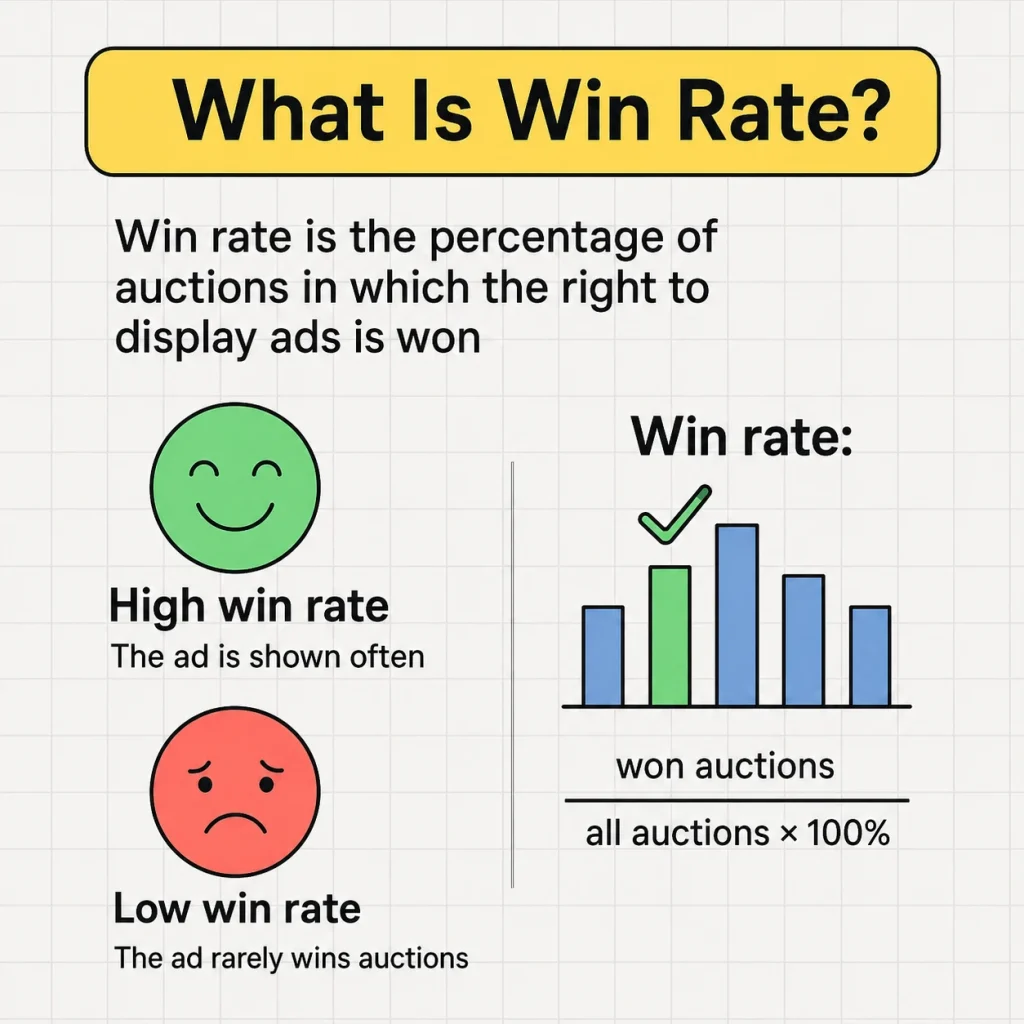
The win rate formula is simple:
(Won Auctions ÷ Total Auctions Entered) × 100%
For example, if your campaign entered 1,000 auctions and won 200 of them, your win rate would be:
200 ÷ 1,000 × 100 = 20%
You can find win rate directly inside some ad platforms. Google DV360, for example, has an Auction Win Rate metric, while TikTok Ads and MyTarget provide similar data in campaign reporting.
Meta (Facebook and Instagram), however, doesn’t show win rate as a standalone metric. Instead, media buyers usually rely on indirect indicators:
- Auction Overlap shows which advertisers you’re competing against in the same auctions. It won’t tell you how many auctions you’re winning, but it can help identify whether your own ad sets and creatives are competing with each other.
- Delivery Diagnostics and Delivery Insights can reveal whether a campaign is struggling to get impressions because of low bids, audience saturation, or strong competition.
Pro tip: if a Meta campaign has decent CTR but low impression volume, most buyers will look at competition levels, bid strategy (Bid Cap or Cost Cap), and delivery status rather than trying to find a win rate metric that doesn’t exist.
There isn’t a universal benchmark for a “good” winrate. It depends on several factors:
- Traffic source. A 30-40% win rate may be perfectly fine on Meta, while TikTok often delivers higher numbers. In highly competitive auctions, the winrate naturally drops.
- Vertical. Gambling is significantly more competitive than niches like nutra or e-commerce.
- Seasonality. During major sporting events and other peak periods, advertisers increase bids, making auctions more expensive and harder to win.
That’s why the win rate should never be viewed in isolation. The number only becomes useful when you compare it against CPC, traffic volume, and overall ROI.
Why Win Rate Matters So Much in Gambling
The conversion window is short
Gambling users rarely stay “hot” for long. Someone may be searching for casino bonuses, checking slot reviews, or playing demo games right now. If your campaign loses the auction at that exact moment, the conversion usually goes to someone else.
In other words, the win rate determines whether your ad gets in front of the user when it matters or misses the opportunity completely.
Auctions are tougher than in most other verticals
iGaming advertisers are willing to pay aggressively because player LTV can be extremely high. That creates fierce competition for impressions.
As a result, winrate becomes a useful signal of how competitive your campaigns really are. If it’s consistently low, there’s a good chance your bids aren’t keeping up with the market and traffic is flowing to competitors instead.
It affects the numbers more than most beginners realize
Imagine your CTR looks healthy, but your sales win rate is low. The issue isn’t ad engagement — it’s the fact that you’re not winning enough auctions to generate meaningful volume. With fewer impressions, campaign algorithms receive fewer signals and conversion events. Optimization slows down, scaling becomes harder, and ROI often suffers over time.
A campaign can look profitable on paper while still failing to generate enough volume to become truly scalable. At its core, win rate is directly tied to campaign efficiency. When it drops, you’re simply winning fewer impressions, even if your budget stays exactly the same.
What Should Affiliates Pay Attention To
Bid level
Your bid is one of the biggest factors affecting win rate. In most cases, higher bids increase your chances of winning auctions. However, bid alone doesn’t determine the outcome. Most advertising platforms use some version of an auction ranking system where both bid and ad quality are taken into account.
A weak creative won’t necessarily win just because you’re bidding more. That’s why raising bids should usually go hand in hand with improving creatives, CTR, and overall ad relevance. Otherwise, higher costs can quickly eat into your margins.
Traffic source and placement
Win rate is always platform-specific. As mentioned earlier, Meta doesn’t provide a direct win rate metric, while other platforms do. Benchmarks can also vary significantly between placements such as Feed, Stories, Reels, push traffic, or TikTok inventory.
Comparing winrate across different traffic sources rarely makes sense because each platform runs its own auction environment.
Seasonality and competition
Major tournaments, holidays, and trending events typically bring more advertisers into the market. Competition rises, bids increase, and win rates often decline.
That’s completely normal. Focus on trends over time rather than judging performance from a single snapshot.
GEOs and audiences
Not all audiences are valued equally. Tier-1 countries attract far more competition than lower-tier markets, which usually results in lower win rates and higher acquisition costs. This is one of the reasons many affiliates expand targeting or test alternative GEOs when scaling campaigns.
There is no fixed win rate that works everywhere. Results vary depending on seasonality, GEO, vertical, traffic source, and overall competition. That said, many iGaming affiliates aim for at least a 30-40% win rate when scaling campaigns. As a general rule, anything above 40% is often considered healthy enough to maintain stable impression volume and consistent traffic delivery.
How to Increase Win Rate in Affiliate Marketing

Some affiliates run casino offers, others focus on sports betting, while some are testing crypto campaigns. The one thing they all have in common is that they’re competing in the same auctions.
At the same time, gambling traffic is highly time-sensitive. Users are actively looking for bonuses, free spins, betting promos, and other offers right now. If your ad loses the auction, there’s a good chance that player ends up with a competitor instead.
If you want to win more auctions and keep your win rate healthy, here are a few proven ways to do it.
Review and Adjust Your Bids
Most ad platforms offer two bidding approaches:
- Manual bidding — you set your own CPM or CPC and directly control how aggressively you compete in auctions.
- Automatic bidding — the platform adjusts bids automatically based on your campaign goal, whether that’s clicks, conversions, registrations, or deposits.
To improve the win rate in sales, you first need to understand how competitive your current bid is. In platforms like Yandex Direct, advertisers can estimate average bids within similar audiences and campaigns, then slightly increase CPM to win more auctions without dramatically increasing costs.

Meta works a bit differently. Since there is no direct win rate metric, buyers typically rely on Delivery Diagnostics and other delivery-related indicators to understand whether campaigns are being limited by budget, bid levels, or competition.
Many affiliates also test Bid Cap and Cost Cap strategies, gradually increasing bids while monitoring traffic volume and acquisition costs. This approach helps identify the point where additional spend starts producing meaningful delivery gains.
Pro tip: test bids during lower-competition hours whenever possible. Auctions are often cheaper and easier to win. Just make sure you’re looking at the audience’s local time zone, not your own. Midnight for you could be peak traffic hours in your target GEO.
Choose the Right Buying Strategy
Your bidding strategy has a direct impact on win rate. Most advertising platforms offer several optimization models:
Maximize Impressions / Reach / Awareness
The system prioritizes winning as many auctions as possible. Winrate is typically higher, although CPM and CPC may increase as a result. This approach often works well for time-sensitive iGaming campaigns where visibility matters and missing a potential player can be costly.
Conversion Optimization / Auto Bidding
Here, the platform automatically adjusts bids to hit a target CPA, CPL, or ROI. In some cases, overall win rate may decline because the algorithm becomes more selective about which auctions it enters. On the other hand, if you’re targeting a narrow audience, auto bidding can actually improve winrate within that specific segment.
Hybrid Strategies
Many experienced affiliates combine manual limits with automated optimization. For example, you can cap maximum CPM while allowing the algorithm to optimize toward registrations or first-time deposits. This helps maintain delivery volume without overpaying in every auction.
Pro tip: always monitor win rate trends within your chosen strategy. If performance starts slipping, check whether the campaign is losing auctions because of bid levels or audience restrictions. Sometimes a small 5-10% bid increase in the right segment is enough to produce a noticeable jump in win rate.
Cut Underperforming Placements
Not all traffic sources are worth fighting for. A placement may generate plenty of impressions and even show a strong win rate, yet deliver little to no conversions. In that case, you’re winning auctions but not making money.
Removing weak placements allows you to redirect budget toward inventory that actually produces clicks, registrations, and deposits. This also improves optimization. Delivery algorithms receive stronger conversion signals, budget allocation becomes more efficient, and campaigns spend less money on low-value traffic.
A few examples:
- Google Search: add negative keywords and remove search terms that generate clicks without conversions.
- Display, Facebook, TikTok: exclude placements, websites, or audience segments with high CPMs and poor conversion rates.
As a result, your budget is concentrated on traffic that performs. The system can compete more effectively in valuable auctions instead of spreading spend across inventory that isn’t producing results.
Improve Creatives and Landing Pages

Win rate is closely tied to CPC and eCPM. If your CTR is weak, ad platforms will rank your ads lower — which means you lose more auctions and get fewer impressions.
Here’s what matters in practice: a strong, specific offer (like “50 free spins no deposit” or “10% weekly cashback”) usually drives higher CTR. And higher CTR improves your ad quality score, which makes it easier to win auctions at the same or even lower bids.
Landing pages also play a role. They need to load fast and communicate the offer immediately. If the page is slow or unclear, conversion rates drop, and the platform eventually “learns” that your traffic is lower quality — which indirectly affects delivery and win rate.
Simple chain:
Better CTR → higher ad quality → better auction ranking → higher win rate
Pro tip: sometimes even small changes — a new hero image, a clearer CTA button, or removing friction from the landing page — can noticeably improve auction performance and increase win rate.
Use Automation for Bidding
Manual bid management doesn’t scale well. Auctions change every second, and reacting to them manually is almost impossible once you start scaling. Inside most ad platforms, you’ll usually work with:
Manual bidding (manual CPM/CPC)
Full control over bids. You can push or lower bids per segment, GEO, or placement, but it requires constant monitoring and adjustments.
Auto bidding / conversion optimization
The system adjusts bids automatically to meet a target (CPA, CPC, or ROI). In some cases, the winrate can increase if your manual bids were too low — but it can also decrease if the algorithm decides to reduce spend to stay within cost targets. So win rate improvement here is not guaranteed.
Bid adjustments
Most platforms allow bid modifiers based on device, GEO, time of day, or placement. This is often the most practical way to fine-tune win rate without losing control of overall campaign logic.
On top of that, tools like AdEspresso, Revealbot, Smartly.io, and similar automation platforms help manage bidding rules, budget allocation, and scaling. They don’t “magically” increase win rate, but they make it easier to maintain stable delivery while optimizing performance across segments.
Test and Analyze

Different formats and approaches affect win rate in different ways: video and native ads often deliver higher CTR, which lowers eCPM pressure and increases the chances of winning auctions. In simple terms, better engagement usually means better auction performance.
Remarketing works with “warm” audiences. Users already know the offer, so CPC is usually lower, and the probability of winning auctions is higher compared to cold traffic.
The key is to continuously test targeting and creatives while tracking core metrics: CTR, CPC, eCPM, and win rate. A drop in win rate is usually a signal that something needs adjustment — either bids or audience settings.
The formula is straightforward:
Higher CTR + correct bidding + precise targeting = higher win rate without unnecessary cost inflation
Pro tip: don’t assume your static banners are the best-performing format just because they look good. In many cases, switching to short-form video can increase win rate by 10% or more in the same traffic source.
Win rate is not a goal on its own. It only matters when it works together with campaign economics — CTR, CPA, and ROI. Think of it like a puzzle: the result only makes sense when all parts fit together.
You can improve winrate by combining tighter targeting, stronger creatives, better landing pages, and smarter bid automation. Every adjustment affects the auction outcome: better ads and optimized bids win more impressions → more traffic → more consistent conversions.
Work step by step, measure changes properly, and your traffic becomes more predictable and profitable over time. When everything is aligned, auctions start “favoring” your campaigns more often, and your iGaming offers get more stable delivery.
Conclusion
Win rate is a signal of how competitive your campaign is in a specific auction environment. A high one usually means your bids, creatives, and targeting are well balanced, and your buying strategy matches the level of competition. A low winrate is a warning sign that your campaign is losing impressions and needs adjustments — whether in bidding, creative quality, audience selection, or overall setup.
To improve win rate consistently, you need a full-stack approach: test creatives and landing pages, refine targeting, optimize bids, and automate repetitive optimization tasks where possible.
Want to get more performance out of your campaigns? Join 888STARZ Partners, follow our updates, and use proven tools to scale your traffic. Let’s make your campaigns more efficient and your win rate stronger across the board.
Publication date25.06.2026